
- Machete: REAT 24 inch heavy duty model, a full tang 420 stainless blade with a non-slip rubber handle, built to slice through brush and vines.
- Hatchet: REAT 10 inch camping axe, a compact full tang hatchet with a black wood handle, 3 hex wrench slots and a secondary edge.
- Rule of thumb: a long, thin machete sweeps through soft green growth; a short, wedge-shaped hatchet splits and chops dry wood.
- Middle ground: the 17 inch REAT machete with a saw back chops and saws, for small branches as well as brush.
- Both ship with a sheath. Keep them covered whenever they are not in use.
Machete vs hatchet is a classic outdoor question, and the honest answer is that they solve different problems. A machete is a long, thin blade swung to slice through brush, tall grass and vines. A hatchet is a short axe with a heavier, wedge-shaped head that bites into and splits wood.
To keep the comparison concrete, we put two REAT tools side by side: the 24 inch heavy duty machete from the machetes range and the 10 inch camping hatchet from axes and hatchets. All specs come from the maker's listings.
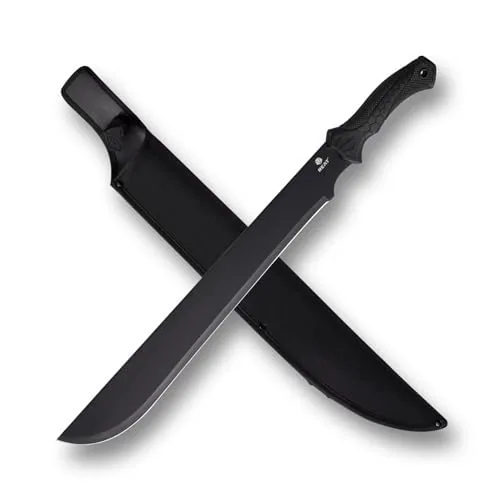
REAT Heavy Duty Machete with Sheath,24 inch Full Tang 420 Stainless Steel Blad
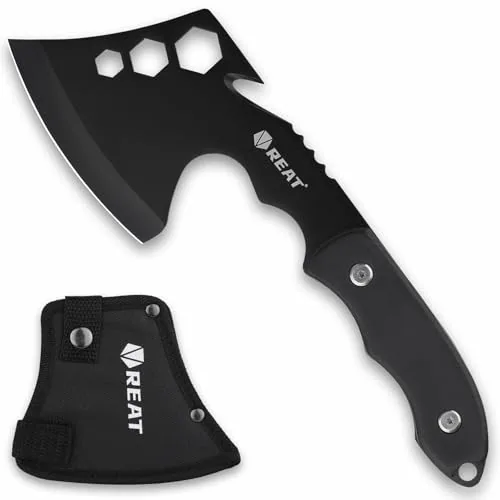
REAT 10" Camping Axe and Survival Hatchet with Sheath
Machete vs hatchet: specs side by side
Here is what each listing states, plus the 17 inch REAT machete with saw as a middle option.
| REAT 24 inch machete | REAT 10 inch hatchet | REAT 17 inch machete with saw | |
|---|---|---|---|
| Overall length | 24 in | 10 in | 17 in |
| Steel | 420 stainless | Black-coated blade (grade not stated) | 420 |
| Construction | ✓ Full tang | ✓ Full tang | ✓ Full tang |
| Handle | Non-slip rubber | Black wood, anti-slip | Ergonomic non-slip |
| Extra functions | Machete, knife and saw use, per listing | 3 hex wrench holes, secondary edge | Chopping and sawing |
| Sheath | ✓ Included | ✓ Oxford sheath with belt loops | ✓ Included |
| Gift box | ~ Not mentioned | ✓ | ~ Not mentioned |
| Warranty | 30 days from purchase | Not stated | 30 days from purchase |
Overall length
Inches, from each listing
The machete is 2.4 times the length of the hatchet. That extra reach is the whole point for brush, and the whole problem in a backpack.
What is a machete best at?
A machete works by speed rather than weight. The long, relatively thin blade slices through soft, green material in a sweeping arc, which is why it is the go-to for overgrown fence lines, bramble patches and narrow trails.
REAT's 24 inch model is described as a full tang 420 stainless steel blade with a non-slip rubber handle. The listing says the grip is meant for precise control and safer use while working in the garden or clearing a camping site. It also calls the tool multi-purpose, combining machete, knife and saw functions.
Where a machete struggles
- Splitting firewood: the thin blade tends to glance off or get stuck.
- Tight spaces: 24 inches needs room to swing safely.
- Packing light: it is long to carry on a day hike.
If you like the idea of a machete but want it shorter, the 17 inch REAT machete with saw adds a toothed back for small branches. More options are in our best machete guide.
What is a hatchet best at?
A hatchet puts most of its mass in a short, wedge-shaped head. That shape drives into wood and pushes the fibers apart, which makes it the better pick for kindling, notching and trimming dead limbs.
The REAT 10 inch camping axe is pitched at chopping branches, preparing firewood and clearing trails. Its full tang design and black wood handle are aimed at a secure grip in wet or cold conditions, according to the listing. Two extras stand out:
- 3 integrated hex wrench holes for quick tent, bike or gear adjustments.
- A secondary edge for scoring bark or cutting rope.
- A high-density Oxford sheath with belt loops and metal fasteners that lock over the head.
REAT Heavy Duty Machete with Sheath,24 inch Full Tang 420 Stainless Steel Blad
Check price →REAT 10" Camping Axe and Survival Hatchet with Sheath
Check price →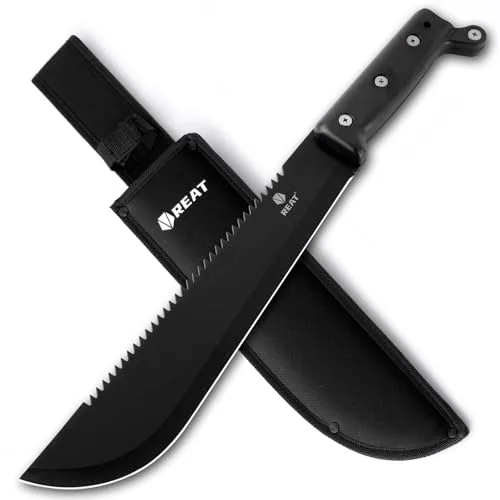
REAT Machete with Saw
Check price →Note that this hatchet is a camp tool, not a throwing axe. If target throwing is what you have in mind, see our best throwing axe roundup.
Which jobs suit each tool?
Use this quick task map as a starting point. A check mark means the tool's design fits the job well; a tilde means it can work with care.
| Task | 24 inch machete | 10 inch hatchet |
|---|---|---|
| Clearing brush, vines, tall grass | ✓ | ✗ |
| Opening an overgrown trail | ✓ | ~ |
| Splitting kindling | ✗ | ✓ |
| Trimming small dead branches | ~ | ✓ |
| Quick gear adjustments | ✗ | ✓ Hex slots |
| Carrying in a daypack | ✗ | ✓ |
Many yard owners and campers end up owning both: a machete for the green growth, a hatchet for the woodpile. For a fine-cutting companion, our best bushcraft knife guide covers REAT's smaller fixed blade knives.
How to choose between a machete and a hatchet
- Name the material. Soft and green points to a machete; dry and woody points to a hatchet.
- Think about space. A 24 inch blade needs a wide, clear swing zone; a 10 inch hatchet works close in.
- Check the handle. Rubber and wrapped handles help when hands are sweaty; wood feels warmer in the cold.
- Look for full tang. All three REAT tools here list a full tang build.
- Plan the carry. A belt-loop sheath suits a hatchet; a long machete is easier to carry strapped to a pack.
In the machete vs hatchet decision, let the material decide. The REAT 24 inch machete is the stronger choice for brush, vines and overgrown trails thanks to its long full tang 420 stainless blade and non-slip rubber handle. The REAT 10 inch hatchet wins for kindling, small limbs and pack-friendly camp chores, with hex wrench slots and a secondary edge as bonuses.
If you want one tool that leans both ways, the 17 inch REAT machete with saw is a reasonable compromise. Browse the full machetes and axes and hatchets ranges, or read our best fixed blade knife guide for a smaller cutting tool.
FAQ
Machete vs hatchet: which is better for camping?
For most campsites a hatchet is the more useful tool, since it handles kindling and small dead wood and packs small. A machete earns its place where you need to clear brush or open a trail.
Can a machete split firewood?
Not well. A machete's thin blade is designed for slicing green material, so it tends to glance off or stick in dry rounds. A hatchet's wedge-shaped head is built for that job.
How long is the REAT heavy duty machete?
The listing states a 24 inch full tang 420 stainless steel machete with a non-slip rubber handle and a sheath.
What are the hex slots on the REAT camping hatchet for?
The listing describes 3 integrated hex wrench holes for gear adjustments and emergency repairs, alongside a secondary edge for bark or rope cutting.
Is a machete with a saw back worth it?
It can be if you meet both brush and small branches. The REAT 17 inch machete with saw is listed for chopping and sawing in one tool.
Is it legal to carry a machete?
It depends on where you are. Many places regulate carrying long blades in public, so check your state and local laws, and transport the tool sheathed and packed away.