
REAT makes fixed blades for people who work and play outside: belt and neck knives, machetes in a dozen lengths and colors, kunai and throwing knife sets, throwing axes, a camp hatchet and a small group of cord-wrapped swords. Each piece is a single steel tool with no folding joint or moving lock, so choosing between them comes down to length, steel, grip material and how the blade is carried.
Three kinds of buyer account for most of the range. Campers, hikers and anglers pick up the short knives for food prep, cord, skinning and small camp chores. Homeowners and bushcraft users reach for the machetes and the multitool hatchet when brush, branches and saplings need clearing. Backyard throwers buy the kunai and axe sets for target games and competition practice, while the swords go mainly to collectors and gift buyers.
Construction choices that repeat across REAT blades
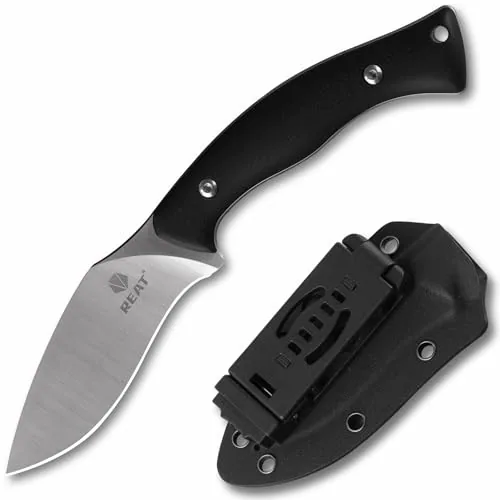
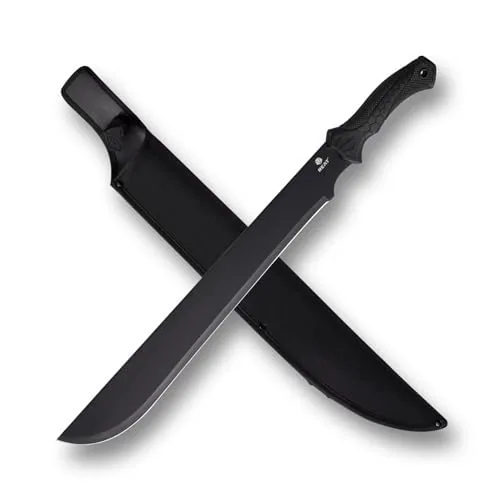
Steel running through the handle is the most consistent detail. The D2, 14C28N, 440C and 8Cr13 knives, nearly every machete from 17 inches up, the camp hatchet, most of the throwing axes and the 9-inch kunai trio are all full tang. On a tool that is swung into wood or thrown into a board, a one-piece core leaves no separate handle joint to loosen over time.
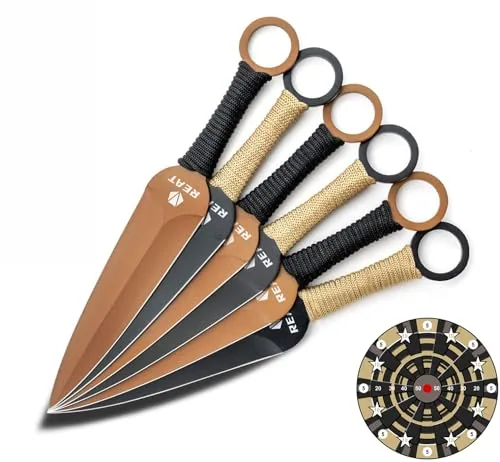
Steel grade changes with the type of tool. The small carry knives use D2, 14C28N, 440C or 8Cr13, and several have a CNC water-ground edge for clean detail cuts. The machetes and three of the throwing axe sets are 420 stainless steel, and the kunai, the 9.5- and 11-inch axes and two of the camp knives use 440 stainless. Gray, black and green coatings appear on some throwing pieces and on the 25.5-inch machete for added corrosion resistance.
Grips vary more than steel does. G10 and ABS on the knives, rosewood and plain wood on the outdoor pieces, non-slip rubber on the shorter machetes, TPR on the double edged knife and cord wrap on the long machetes, swords and many kunai each give a secure grip in a different way. A wet day in camp is where the rubber, TPR and G10 handles earn their place.
How to read the sizes and specifications
Length figures are where buyers most often get caught out. On the knives, the number in the title describes the blade alone, so a 4-inch knife has about 4 inches of steel ahead of the handle. The 25-inch swords and the 26- and 27-inch cord-wrapped machetes are measured tip to pommel instead: each carries a 15-inch blade and a 7-inch handle. The 16-, 17-, 19- and 24-inch machetes name blade length, which means a 24-inch model reaches further than a 27-inch cord-wrapped one.
On the knives, edge shape is the second figure worth checking. Most are clip point, the 2.99-inch neck knife is a spear point, the gut hook model adds a hook for field dressing, and the 4.3-inch 8Cr13 knife is sharpened on both edges. Blade thickness appears only on the neck knife, at 3 mm.
Set counts on the throwing gear decide how often you walk to the target. A three-piece set suits one thrower working on form, while six- and twelve-piece sets let two players share a session or let one thrower practice longer between retrievals.
Who the REAT range suits, and who it does not
The range fits weekend campers, hikers, anglers, people who field dress game, gardeners with brush to clear and families who set up a target board in the yard. Gift boxes on the D2 knife, the double edged knife, the red sword and one blue machete make those items easy to wrap for a birthday or holiday.
It is a poor match for anyone who needs a folding pocket knife, a kitchen set or a full-size felling axe. The 3-piece throwing axe set is meant for targets and not for splitting firewood, the neck knives are too small for chopping, and the longest machetes are awkward in tight spaces. The swords are display, collecting and practice pieces rather than yard tools.
Rules on fixed blades, double edged knives, throwing knives and swords vary by state and city. Before buying, travelling with or carrying any piece, check local laws on blade length and carry.
Care, storage and safe handling
Almost every piece comes with an included sheath in Kydex, leather, nylon, Oxford fabric or plastic, which makes safe storage and transport straightforward. A sheathed edge in a pack or truck box goes a long way toward reducing the risk of accidents, and the belt and backpack sheaths keep a knife easily accessible without an exposed edge.
Cleaning takes a minute. Wash off sap and soil, dry the steel completely and let cord-wrapped or wooden handles dry before the blade goes back into its sheath. Leather sheaths should dry slowly at room temperature, and a few drops of oil on the blade before long storage help stainless steel stay bright.
For throwing, a dedicated target, clear ground behind it and a lane free of spectators matter more than which set is chosen. For chopping, gloves and eye protection are worth wearing, and every blade belongs out of reach of children between uses.
Pick the right blade for the job
Fixed blade knives, machetes, throwing knives, swords and hatchets with listed steel, length and sheath. Check local laws and today’s price on Amazon.